In this day and age, with diets masked as wellness and self-care, GLP-1’s and their visible effects everywhere, and social media putting it all in front of us in a very edited way 24/7, it becomes easy to wonder what a good relationship with food even looks like. And we might wonder why so many ‘non-eating-disordered’ individuals around us, or on our phones, seem to exhibit so many of the behaviours that we are trying so hard to heal and move away from….
The truth is that disordered eating happens on a spectrum, and if a truly good relationship with food is on one end, and severe eating disorders are on the other, then most of society seems to fall more in the middle…. Which can be so confusing, and challenging, when trying to recover.
So I thought I would describe, in my own words and also the words of some of my favourite dietitians in this space, such as Evelyn Tribole and Elyse Resch of Intuitive Eating and Ellyn Satter of Competent Eating, what we could aspire to as we recover.
So, what does a healthy relationship with food actually look like? And I mean not just physically healthy, but mentally and emotionally healthy as well?
A healthy relationship with food definitely does not mean always making the right choice, or feeling calm around eating every moment of every day.
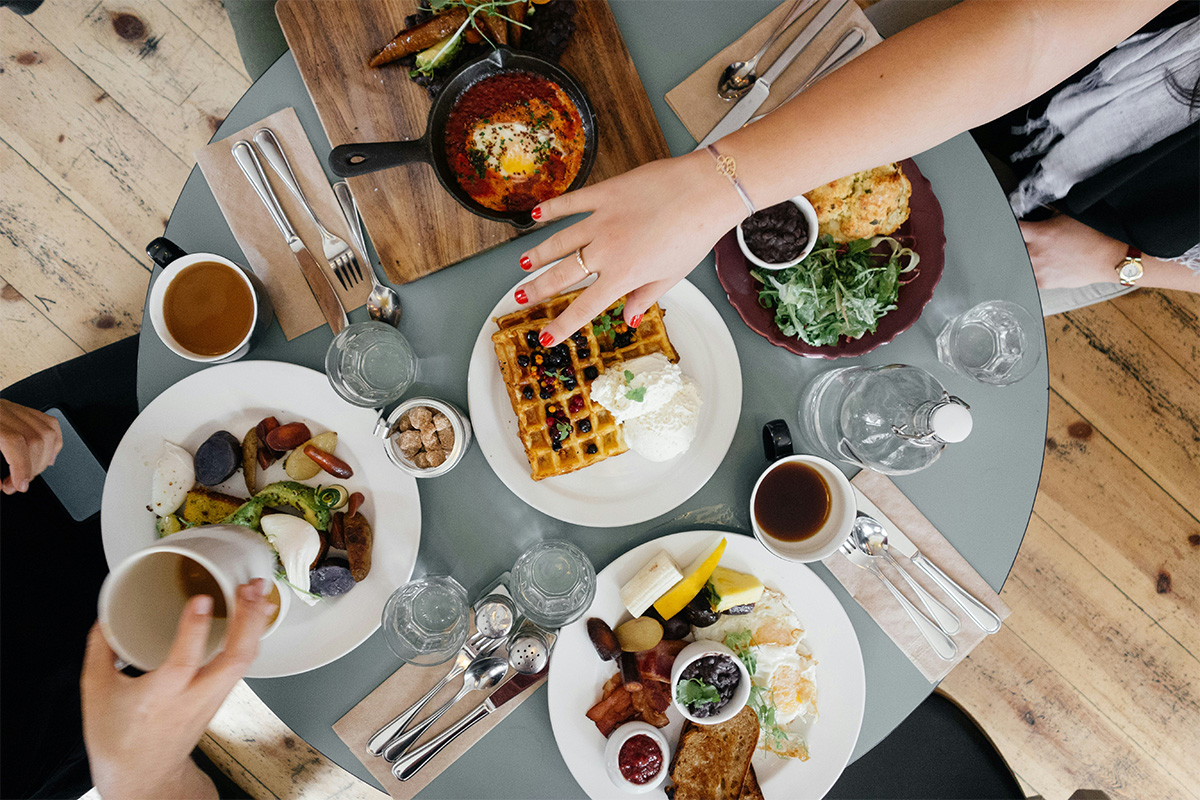
At its core, it really means that food is no longer a constant source of stress, guilt, or self-judgment. It means that eating is guided less by rules and fear and more by attunement, trust, nourishment, satisfaction and enjoyment, and practical care.
This understanding is deeply supported by the work of Evelyn Tribole and Elyse Resch’s Intuitive Eating and by Ellyn Satter’s feeding and eating frameworks. While each approach has its own language, both point toward similar truths: that people do better when eating is rooted in trust, consistency, enoughness, enjoyment and respect.
Signs of a Healthier Relationship with Food
From my experience, a healthy relationship with food includes:
- Giving yourself permission to eat all foods (that you are not allergic or truly intolerant to!) And of course there is room for a vegan or vegetarian diet to come from a non-eating-disordered place, the same as with religious-based ways of eating.
- Not labeling foods as “good” or “bad” in your mind.
- Learning how to notice and feel, and honour and respond, to hunger
- Letting attunement to your felt sense of fullness guide when to stop, in a flexible and relaxed way
- Letting satisfaction and joy in food and nourishment matter
- Eating consistently and reliably so that your body can begin to feel safe (during recovery, this can look like following a meal plan vs relying on hunger and fullness signals to guide you)
- Feeling more flexible when plans, meals, or cravings change
Of course, this type of flexibility, joy, and attunement is very hard when the fear of weight gain is predominant… which is why there is so much work and healing in recovery to do, and why this type of relationship with food takes time to develop. It does not happen overnight, but rather it is the gradual building of trust over time and practice, and many ups and downs along the way.
What This Can Look Like in Everyday Life as You Recover
Working towards:
- Eating regular meals and snacks (perhaps following a meal plan from a dietitian at first)
- Allowing enough food without needing to earn it (a good dietitian can also help guide this)
- Choosing foods you enjoy as well as foods that feel nourishing
- Not trying to compensate for eating
- Getting curious about your body’s cues
- Bringing gentleness and self-compassion to moments that trigger shame
For many, this also means learning structure before full flexibility. That is one reason Ellyn Satter’s work can be so grounding. Her approach reminds us that reliable, adequate eating can help create the safety needed for trust to grow. Her work can be found here, and you could also search out a dietitian to work with who is knowledgeable of or certified in her approach. Working with a dietitian certified in Intuitive Eating can also be extremely helpful as recovery progresses, and they can be found here.
A Gentle Reminder
If you have a history of dieting, disordered eating, or an eating disorder, a healthy relationship with food may not begin with “just listen to your body.” Body cues can feel muffled and confusing when the body has not been consistently fed or when eating has been shaped by fear for a long time, and so it can mean that healing and developing a healthy, attuned relationship with food may need support, structure, and time.
Final Thoughts
A healthy relationship with food is not about perfection, but rather about becoming more connected, flexible, and trusting over time. It is about moving away from control, fear, and shame and towards trust, attunement, flexibility, satisfaction and joy. And this is a huge shift that requires much internal healing and work. And an incredible amount of patience, courage, determination, and discomfort tolerance along the way. And of course, it is only made harder when the world around us is often far from an aspirational example…. One step at a time, one day and meal at a time, and deep change can truly happen…..
With so much admiration, and belief in you,
Support For Your Journey
If you feel you could use more support on your eating disorder recovery journey I would love to connect with you. Contact me to book a free video discovery call so that we can explore if working together would be a good fit. I would love to hear from you.